Using super-intervals to enhance statistical sensitivity of cardiovascular parameters detection
Prolongation of the QTc interval is the primary endpoint and surrogate biomarker used to monitor abnormal cardiac repolarization following drug treatment1.
However, there is a high degree of natural variability in any ambulatory cardiovascular assessment, and detecting cardiovascular changes of small, but biologically relevant, magnitude can be challenging.
The use of larger time-averaged data “bins” called “super-intervals” improves statistical sensitivity to detect QTc interval prolongation and thus allows to get more robust QTc datasets with reduced signal variability.
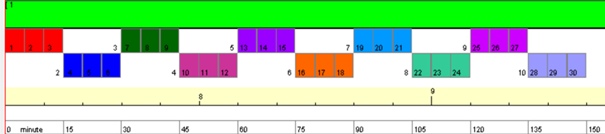
To create super-intervals in our ecgAUTO software, the user must create protocol instructions to bin average values of physiological parameters (heart rate, blood pressure, body temperature, or activity) in “steps”, for instance every 1-5 minutes, and then further average group of steps in “trains”.
In the example below, each color represents a super-interval averaged every 15 minutes, from data averaged every 5 minutes.
Figure 1: Example of data averaged each 5 min, then further averaged every 15 minutes (global and trains sections)
These data can subsequently be used for statistical analysis in separate software, such as ExcelPython, SPSS, SYSTAT, or Prism.