Cardiac arrhythmias, also known as Heart arrhythmia, dysrhythmia, or irregular heartbeat, are disorder where the heart beats with an irregular rhythm, due to a change in the electrical impulses to the heart. These changes affect the heart’s ability to pump blood effectively, leading to other organs (i.e. lungs) becoming damaged.
Understanding arrhythmia mechanisms and evaluating new therapies require accurate, high-resolution cardiovascular data acquisition systems and reliable analysis tools.
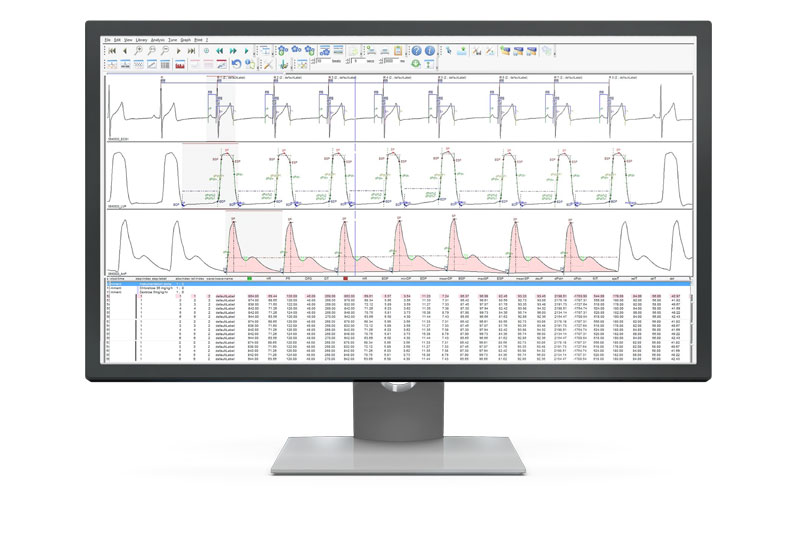
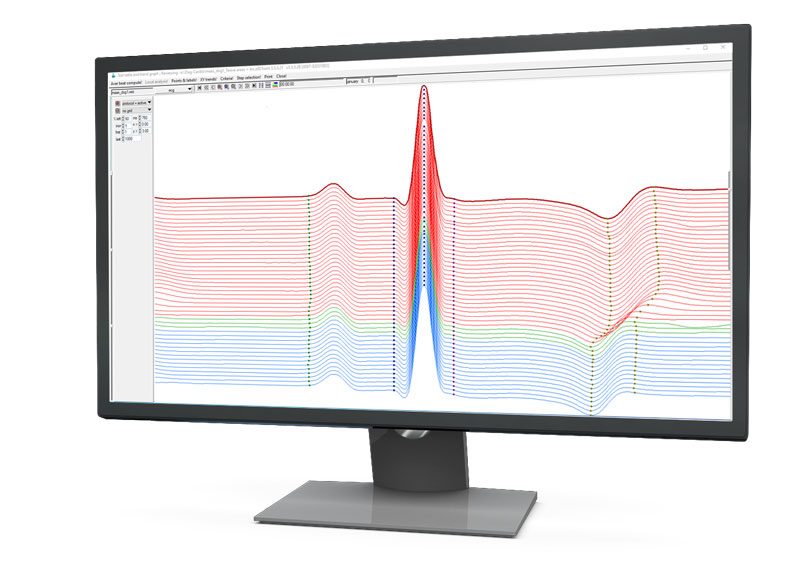
ecgAUTO is a powerful cardiovascular analysis software designed to streamline arrhythmia detection in preclinical studies.
Key capabilities:
Automated detection of arrhythmias with shape recognition technology
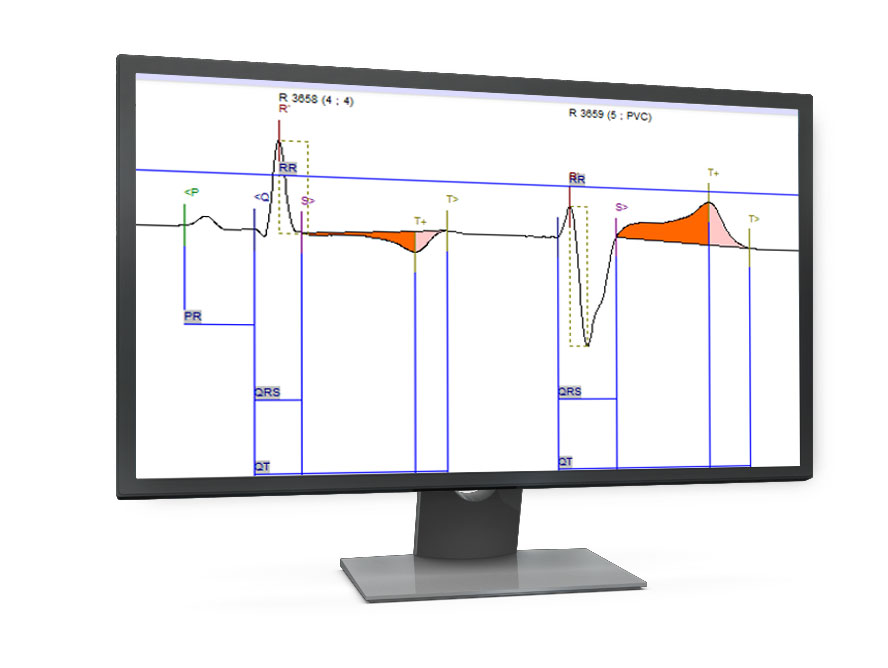
In-depth ECG interval analysis (QT, PR, RR, etc.)
Simultaneous multi-parameter analysis
Arrhythmia counts, count by types, and location of each arrhythmia
Customizable libraries for different species and study models
This approach significantly reduces analysis time while maintaining high data quality, enabling faster and more reliable insights.
Types of Cardiac Arrhythmias
Arrhythmias can originate from different regions of the heart and are commonly classified into:
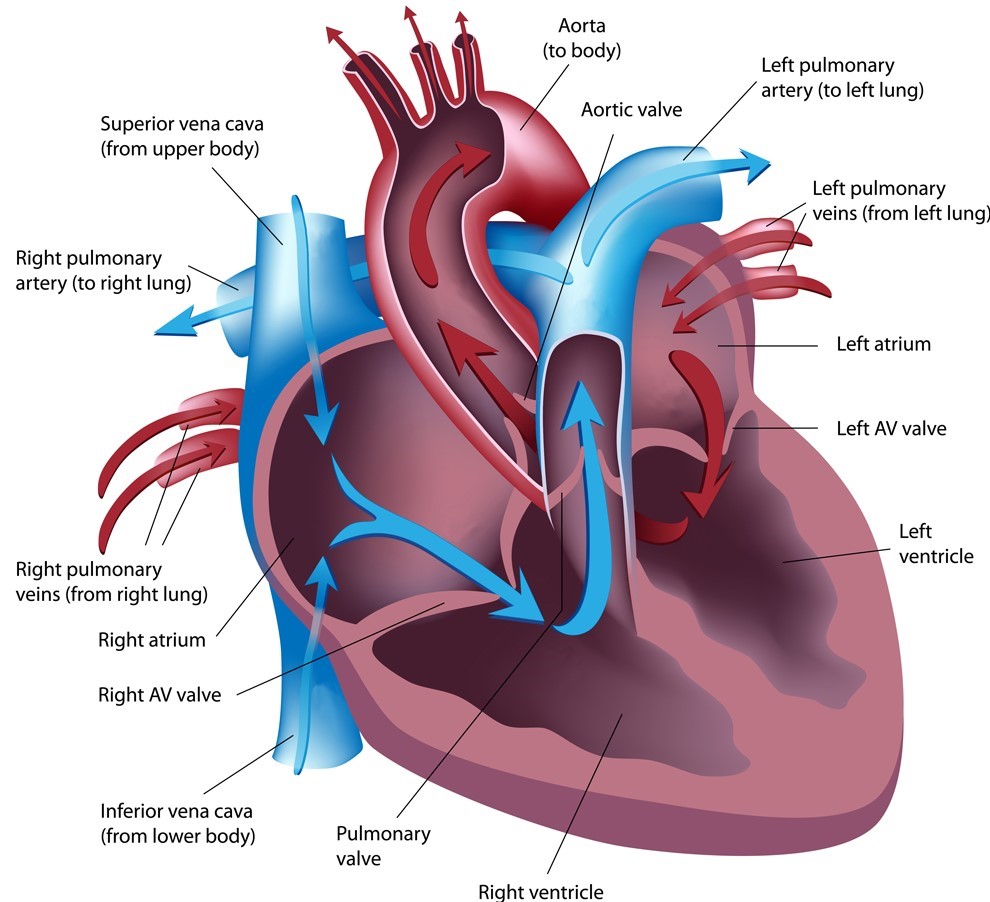
Ventricular arrhythmias originating in the lower chambers of the heart (ventricles), including ventricular tachycardia, ventricular fibrillation, premature or extra heart beats, and Torsade de Pointes.
Supraventricular (atrial) arrhythmias arising in the upper chambers (atria), such as atrial fibrillation, atrial flutter, atrial tachycardia, and paroxysmal supraventricular tachycardia.
Junctional arrhythmias originating from an ectopic focus within in the atrioventricular (AV) junction.
Heart blocks: Also known as AV blocks, caused by impaired conduction at the AV node and a common cause of bradycardia.
Proarrhythmia: a drug-induced worsening or new occurrence of arrhythmias, often triggered by antiarrhythmic or other medications.
Using Shape Recognition
Shape recognition for ECG analysis has been used in ecgAUTO for more than 15 years and has proven its reliability:
Build or customize waveform libraries
Detect both standard and rare arrhythmias
Continuously refine analysis with new morphologies
Reanalyze datasets rapidly with updated libraries
Optimize arrhythmia detection by assigning priority levels to waveform library:
Analyze standard ECG waveforms first
Then apply lower-priority to remaining (abnormal) patterns, allowing adjustable precision by waveform or priority.
ecgAUTO provides 22 types of parameters, such as interval duration, amplitude, area under the curve, preset and custom computed parameters, logical operators, etc. Each one can be used once or more in a configuration, and all are user configurable.
Combinations of parameters can be saved as templates for later use. A configuration may contain multiple such templates. For example, to detect arrhythmia, one may combine with logical operators (AND, OR) parameters that detect:
Sudden change in RR
Sudden change of any other parameter (T area for example)
Parameters that exceed preset values.
Match with a specific waveform, or subclass of waveforms.
Example:
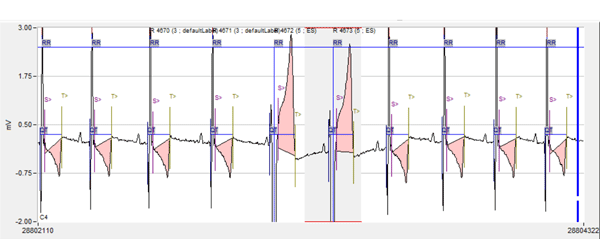
Analysis from specific waveform shape. In the example aside, a PVC is used.
False positive discrimination using amplitude, T wave area, or T-peak height.
Detecting Runs
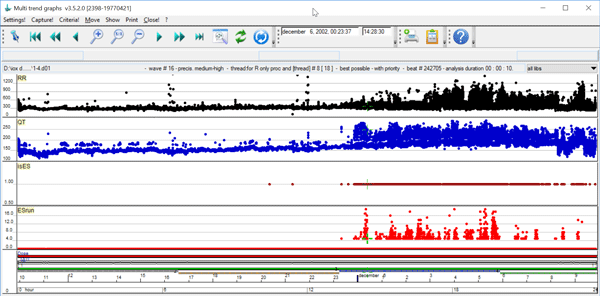
Location, count, and summary of “arrhythmia runs” can be provided by specific parameters. For instance, it is possible to detect “runs” when a class of specific waveform shapes are matched, consecutively, a minimum number of times.
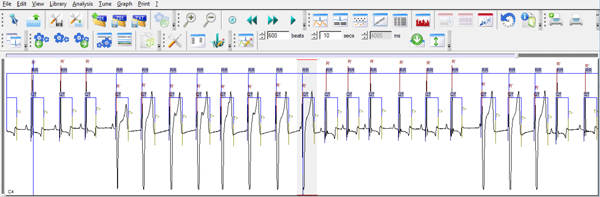
Runs are represented by cluster of red dots in the lower trend graph in red. Clicking on any of these dots brings back the corresponding signals in the main screen as shown in the next graph.
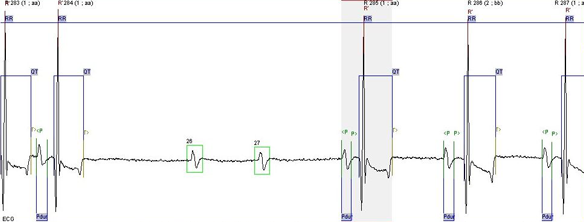
Isolated P-waves
Isolated P-wave is among the events that the software can detect. They are available as one of the standard parameters, reported in a specific list and outlined on the trace.