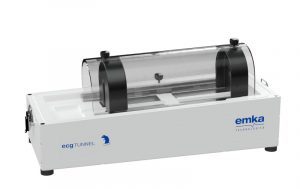
ecgTUNNEL is a plug-and-play system for snapshot ECG* recordings and respiration data in rodents that eliminates the need for surgery and anesthesia.
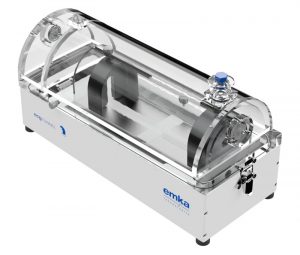
It combines up to 6-lead ECG with an optional plethysmograph dome for respiratory endpoints with optional exposure and infusion options.
This set up is particularly useful for snapshot recordings during sessions lasting a few minutes. It is often used for longitudinal studies where the subjects are studied on successive experiment days, or when subjects are particularly fragile and cannot tolerate surgery or anesthesia.
In an interview, Kimberly Londer BS, from the University of Maryland, said, “there are few systems, publications, or data that exists on small animal ECG without the use of anesthesia or telemetry.” Using ecgAUTO, she “scan[s] an entire recording for AF, ventricular disorders and other arrhythmias of interest within seconds.”
*Electrocardiogram
The basic system consists of:

To perform respiration measurement by plethysmography, the following hardware is added to the basic system:
| Specifications | Mouse | Rat | Subject weight | 15-60 g | 300-1100 g |
|---|---|---|
| Restrainer diameters | 20, 25, 32, 40 mm | 50, 60, 70, 80 mm |
| Restrainer length | 120 mm | 270 mm |
Simply allow the animal to slide into the tunnel, then adjust the front and rear paddles to match its size. Ensure that the paws are properly positioned on the contact electrodes beneath the animal, and the system is ready for recording.
Upon the recommended acclimation protocol, animals show low stress in the ecgTUNNEL.
Acclimation to the ecgTUNNEL is generally straightforward.
Having the animal restrained limits the duration of the recording by around one hour, but typical recordings are usually 5 to 15 minutes long.
For long-term recording, we recommend using implantable telemetry.
When ecgTUNNEL is used with its optional plethysmograph dome to add respiratory endpoints to the ECG, recording duration is also limited. However, for respiratory measurements only, if the ECG restrainer is removed and the chamber is properly ventilated, the animal remains conscious and freely moving and can therefore be recorded for several hours, as in a conventional plethysmography experiment.

The ecgTUNNEL has been used successfully for several years in both academic and private research.
Its use is supported by numerous peer‑reviewed publications, demonstrating reliable ECG data collection across a wide range of preclinical applications.
A list of referenced publications is available here: https://www.emkatech.com/publications/noninvasive-systems/
ecgTUNNEL is not suited to HRV analysis, that requires long-duration recordings. ecgTUNNEL is specifically designed for chronic conditions where short recordings (few minutes) are sufficient. It enables assessment of ECG evolution, intervals, and arrhythmias at a defined time point.
For long-duration monitoring, we provide telemetry solutions (external or implantable) through the easyTEL+ digital telemetry system.
Yes, it is suitable for arrhythmias that are visible on each ECG complex (or a continuous series of complexes), but it is much less appropriate for detecting isolated events that may occur only once every N minutes. For the detection of isolated arrhythmias, we recommend the easyTEL+ digital telemetry system.
Analysis can be performed either through simplified evaluation of averaged complexes using the ecgAVG software module, or via advanced analysis using the ecgAUTO software.
The choice depends mainly on recording duration, study goals, and the level of invasiveness.
ecgTUNNEL is best for:
Jacketed telemetry is suitable for:
Implanted telemetry is ideal for: